
Quick Summary
OEM parts are made to your vehicle’s original specifications, which gives them more predictable fit, especially for electronics and sensors on import vehicles. They usually cost more upfront, but they reduce the risk of repeat repairs and typically carry a clear warranty path through the manufacturer’s network.
- Confirm the part number from your VIN, since year, make, and model miss mid-year changes.
- Aftermarket crash parts averaged 27% less than OEM in one cited study, with sample size unidentified.
- OEM parts matter most for electronics and critical systems that interact with other modules.
- Verify used OEM parts by matching the part number, packaging, and seller documentation.
- Ask for the parts and labor warranty terms in writing before approving any repair.
Table of Contents
- How to Choose OEM Parts for Your Import Vehicle
- What OEM Parts Are and How They Differ From Aftermarket Parts
- OEM Parts Fit and Compatibility for Imported Vehicles
- OEM vs. Aftermarket Parts for Import Vehicles: Side-by-Side Comparison
- Quality, Reliability and Warranty Benefits of OEM Parts
- Pros, Cons and Total Cost of Ownership for OEM Parts
- Used OEM Auto Parts: When They Make Sense and How to Verify Them
- Booking Parts-Specific Service for Your European or Diesel Vehicle
- Frequently Asked Questions
How to Choose OEM Parts for Your Import Vehicle
Last Updated: November 19, 2026
What OEM Parts Are and How They Differ From Aftermarket Parts
Owners of European and diesel vehicles in Milwaukee often ask a simple question: why does the dealer insist on OEM parts when cheaper options are available? OEM stands for original equipment manufacturer, meaning the part is made by or for the company that built your vehicle to its specifications.
Aftermarket parts are made by other companies. Their quality ranges widely, from parts that match OEM closely to parts that simply fit the bolt pattern. Some lower-cost options will work fine for years, while others fail early or fit poorly.
Pricing is the most visible difference. A U.S. Bureau of Labor Statistics price index shows that import prices for motor vehicle parts rose 3.6% from December 2022 to December 2025, including 2.2% during 2025 alone (U.S. Bureau of Labor Statistics, Recent Price Trends in the Motor Vehicle Parts Industry). That index reflects the industry as a whole, not a direct OEM-versus-aftermarket comparison, so check current quotes for your specific part.
OEM Parts Fit and Compatibility for Imported Vehicles
Fit is where imported vehicles most often run into trouble, and the reason is structural rather than cosmetic. A vehicle sold under one nameplate can be built in several plants, for several markets, with several engine and trim combinations, and each combination can carry different brackets, connectors, sensors, and fastener specifications. A part that looks identical on a shelf can sit a few millimeters off, enough to cause a vibration, a leak, or a sensor that reads incorrectly.
The practical consequence is that year, make, and model are not enough to order by. Import-specific fitment usually turns on four variables:
- Model year and mid-year production changes. Manufacturers frequently revise a part during a model year without changing the nameplate. A running change to a connector, a revised sensor, or a superseded part number can mean the early-year and late-year cars take different components.
- Trim and engine code. A diesel and a gasoline version of the same model often share a name but not a single component. Within one engine family, output variants and emissions configurations can also change the parts that bolt to it.
- Regional market specification. The same model sold in different markets may use different emissions hardware, lighting, cooling, or electronic modules to meet local rules. A part correct for one market’s build may not communicate correctly with another market’s control modules.
- VIN-specific part lookup. The most reliable way to select a part is to pull the part number from the vehicle identification number rather than from a catalog that lists by year, make, and model. The VIN encodes the build configuration, and a dealer parts counter or a shop with factory catalog access can decode it.
OEM parts are built to the vehicle’s original specifications, so fit is generally predictable once the correct part number is identified. That predictability matters most for parts with electronic components, sensors, control modules, actuators, where a physically compatible part can still fail to communicate with the rest of the network. For mechanical wear items, the margin for error is wider, but the part-number discipline still applies.
Watch out: ordering by year, make, and model alone is the most common cause of a wrong import part, because it silently ignores mid-year changes and market-specific builds. Confirm the part number against the VIN before you buy, and keep the number on the invoice so a return or warranty claim can be traced.
OEM vs. Aftermarket Parts for Import Vehicles: Side-by-Side Comparison
The table below summarizes the trade-offs for a typical import repair. Your actual results depend on the specific part and vehicle.
| Factor | OEM Parts | Aftermarket Parts |
|---|---|---|
| Fit | Matches original specifications | Varies by manufacturer |
| Price | Usually higher upfront | Often lower upfront |
| Consistency | Predictable from job to job | Can vary between brands |
| Warranty | Typically backed by the vehicle maker’s parts program | Depends on the seller |
| Best for | Electronics, critical systems, newer vehicles | Wear items, older vehicles, budget repairs |
Aftermarket parts can cost less (No easy fix for California’s replacement parts regs). A study covered by the R Street Institute reported that aftermarket crash parts averaged 27% less than OEM parts, though the study’s sample size and year were not identified in the research available to us (R Street Institute, Study finds consumers benefit from aftermarket crash parts). Lower price alone is not the whole decision. Compare fit, warranty and the cost of a repeat repair.
Quality, Reliability and Warranty Benefits of OEM Parts
The main reason owners choose OEM parts is consistency. The part is designed for that exact vehicle and built to the original specifications.
Reliability matters most on systems that interact with others, such as the engine management, transmission control, and driver-assist sensors found in newer imports. A part that is slightly out of spec can trigger warning lights or intermittent faults that take hours to diagnose.
Warranty, Insurance and Repair-Right Implications
Warranty coverage is another practical difference. Before approving a repair, ask three questions: what does the parts warranty cover, how long does it last, and does your insurance policy specify the type of part to be used? Get the answers in writing.
Pros, Cons and Total Cost of Ownership for OEM Parts
Pros of OEM parts:
- Designed for the exact vehicle and its specifications
- More predictable fit, especially for electronics and sensors
- Clear warranty path through the manufacturer’s network
- Lower risk of repeat repairs on critical systems
Cons of OEM parts:
- Higher upfront cost
- Sometimes longer lead times for older or less common imports
- Availability can be limited for discontinued models
Total cost of ownership is the better way to judge the decision. A lower-cost aftermarket part that fails early and requires a second labor charge can cost more over time than a higher-priced OEM part. The reverse is also true: a wear item such as a cabin filter rarely justifies OEM pricing. Pricing depends on the part, the vehicle, and current availability, so request a written quote for each option.
Used OEM Auto Parts: When They Make Sense and How to Verify Them
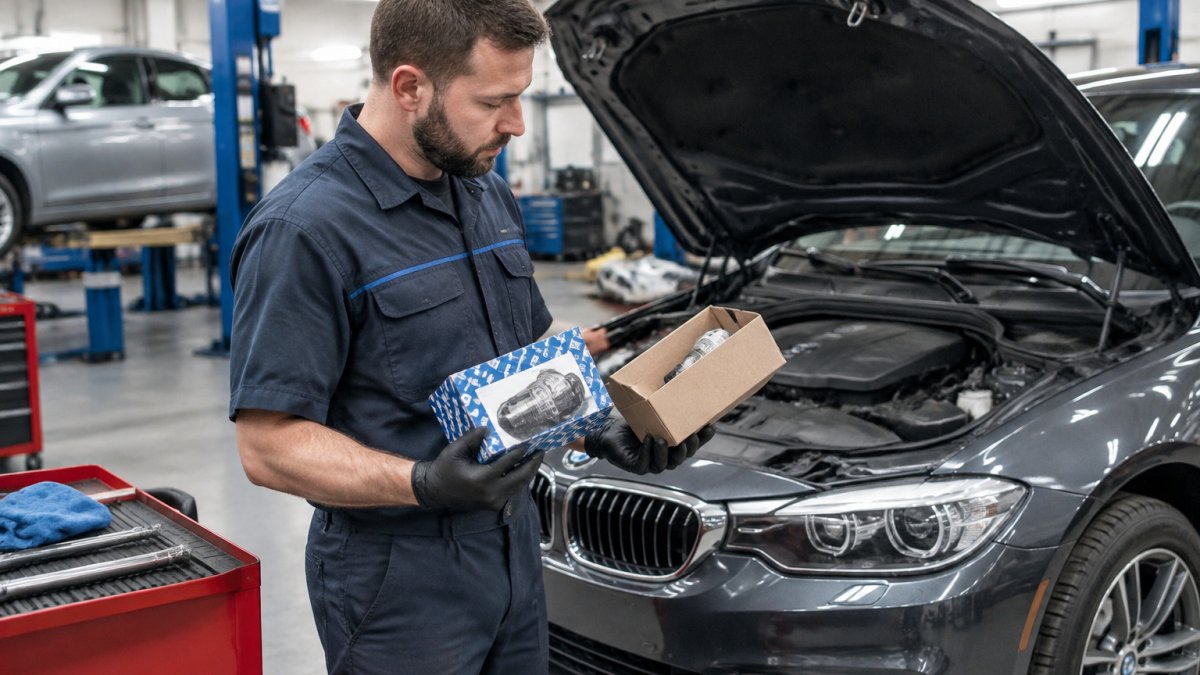
Used OEM parts can be a sensible choice for older imports, body components, or parts that are no longer produced new. You can browse our parts shop to compare what is available. The risk is not that used parts are inherently bad, it is that the market mixes genuine original-equipment take-offs with counterfeit and mislabeled parts, and the buyer usually cannot tell them apart by appearance alone. Verification is the whole job.
Start with the part number. Genuine OEM parts carry a manufacturer part number, usually stamped, cast, or printed on the component itself and repeated on the packaging label. Pull the number for your VIN from a dealer parts counter or a factory catalog, then match it character for character against the number on the part.
Check the packaging and labeling. Original-equipment packaging typically carries the manufacturer’s branding, the part number, and batch or country-of-origin information in a consistent format. Counterfeit packaging often has blurry printing, mismatched fonts, missing batch codes, or branding that imitates the maker without matching it. For a used part, the original box may be gone, so weigh the labeling evidence more heavily on new parts and the physical evidence more heavily on used ones.
Confirm the seller. Authorized dealers and established salvage operations can usually document where a part came from. Ask whether the seller is an authorized reseller for the brand, whether the part was pulled from a donor vehicle with a known VIN, and whether the seller will put the source and the part number on the invoice. A seller who cannot or will not answer those questions is a risk regardless of price.
Inspect the part itself. Look for the original part number, check for cracks, corrosion, bent mounting points, or repaired damage, and compare the connector shape and pin count against the part you are replacing. Electronic modules should be tested before installation whenever possible, because a module that powers up but does not communicate will cost diagnostic time to sort out.
Know the counterfeit warning signs. A price far below the market for the same part number, packaging with no batch or origin information, a part number that does not match the application, and a seller who discourages returns are all common patterns. None of them proves a part is counterfeit on its own, but each is a reason to slow down.
Get the warranty in writing. Ask what the seller’s warranty covers, how long it lasts, and whether it covers labor as well as the part. A used part with a clear return window and a documented source is a different proposition from one sold as-is with no paperwork.
Watch out: a used OEM part that cannot be traced to a part number and a source is not a bargain, it is an unverified component, and the cost of a failed installation usually lands on the buyer.
Booking Parts-Specific Service for Your European or Diesel Vehicle
Choosing the right part is only half the job. The installation, diagnostics, and calibration on European and diesel vehicles often require specialized tools and experience. If you are unsure which part your vehicle needs, book auto repair and diagnostics at Motorplex MKE for a clear assessment before you buy.
Our team can confirm part numbers from your VIN, explain the options for your specific repair, and walk you through the expected results. We also offer flexible financing for repair work if a larger job needs to be spread out, and you can review our parts and labor warranty to see what coverage applies to your repair.
Choosing OEM parts for an import vehicle comes down to fit, risk, and total cost, not just the sticker price. Bring your VIN and your current quote to Motorplex Milwaukee in South Milwaukee, and we will help you decide which option fits your car and your budget.
Frequently Asked Questions
Is it better to use OEM parts or aftermarket parts for an import vehicle?
For most import vehicles, OEM parts are the safer default because they are built to the manufacturer’s original specifications, which supports exact fit and consistent performance. Aftermarket parts can cost less, though a lower price does not establish equivalent fit or durability. Many owners use OEM for safety, electronics and engine components and consider aftermarket for lower-stakes items.
Do OEM parts fit import vehicles better than aftermarket parts?
OEM parts are engineered for the exact make, model, year and trim, so they generally offer the most reliable fitment on imported vehicles. Aftermarket parts may be designed to fit several applications, which can mean minor differences in mounting points or connectors. Having your VIN ready when ordering helps confirm the correct part number.
Can I trust used OEM auto parts?
Used OEM parts can be a sound choice when they come from a reputable source and match your vehicle’s part number. Inspect the part for cracks, corrosion, wear and damage, and ask whether it was tested or comes with any warranty. Genuine parts from authorized channels reduce the risk of counterfeit components. For critical safety or emissions parts, a new OEM component is often the more dependable option.
Are OEM parts worth the extra cost?
OEM parts usually cost more up front, but they can reduce the chance of repeat repairs caused by poor fit or early failure. Total cost of ownership includes labor, downtime and how long the repair holds. Pricing varies by part, vehicle and supplier, so ask for a current quote before deciding. Motorplex Milwaukee offers transparent repair explanations so you can weigh the options with your mechanic.
